PDF Download
Even we talk about the books ; you might not find the printed publications right here. A lot of collections are provided in soft file. It will precisely offer you more advantages. Why? The very first is that you may not need to bring the book everywhere by fulfilling the bag with this It is for guide is in soft documents, so you could save it in gizmo. After that, you could open up the gizmo all over as well as check out the book properly. Those are some couple of advantages that can be obtained. So, take all benefits of getting this soft file publication in this web site by downloading in web link given.

PDF Download
Invest your few minute to check out a book even only couple of pages. Reading book is not responsibility as well as pressure for everybody. When you don't intend to read, you can obtain penalty from the author. Review a book ends up being an option of your different characteristics. Lots of people with analysis habit will always be delightful to check out, or however. Somehow, this tends to be the depictive book in this internet site.
This book is really proper for the book motif that you are searching for now. Several resources could supply the selection, yet can be the most effective means. It is not only one point that you could delight in. More points and also lessons are offered or you to cover exactly what you specifically require. Lots of visitors need to check out the books also due to the specific reasons. Some may enjoy to read it so much however some could require it because the work deadline.
The book can be prepared to have such ideas that might make different points to keep in mind. One is that excellent author always offer the motivating flow, great lesson, and outstanding material. As well as just what to give up is more than it. You could define exactly how this book will get and meet your willingness concerning this related subject. This is the method exactly how this publication will influence people to like it a lot. After discovering the reasons, you will certainly like an increasing number of concerning this publication as well as writer.
To get exactly what you really intend to make, reading this book can be accomplished every single time you have opportunity to review. Yeah, analysis is a needs to from everybody, not only when you are being in the university. Reviewing will make you wiser and also much better in expertise and also lessons. Numerous experiences can be also acquired from reviewing only. So, be smart to get all those take advantage of to read as well as finish.
Product details
File Size: 1319 KB
Print Length: 320 pages
Publisher: PublicAffairs; 1 edition (November 27, 2018)
Publication Date: November 27, 2018
Language: English
ASIN: B07B89VS4P
Text-to-Speech:
Enabled
P.when("jQuery", "a-popover", "ready").execute(function ($, popover) {
var $ttsPopover = $('#ttsPop');
popover.create($ttsPopover, {
"closeButton": "false",
"position": "triggerBottom",
"width": "256",
"popoverLabel": "Text-to-Speech Popover",
"closeButtonLabel": "Text-to-Speech Close Popover",
"content": '
});
});
X-Ray:
Not Enabled
P.when("jQuery", "a-popover", "ready").execute(function ($, popover) {
var $xrayPopover = $('#xrayPop_8A84BC44536611E9BECB368DFDF2066C');
popover.create($xrayPopover, {
"closeButton": "false",
"position": "triggerBottom",
"width": "256",
"popoverLabel": "X-Ray Popover ",
"closeButtonLabel": "X-Ray Close Popover",
"content": '
});
});
Word Wise: Enabled
Lending: Not Enabled
Screen Reader:
Supported
P.when("jQuery", "a-popover", "ready").execute(function ($, popover) {
var $screenReaderPopover = $('#screenReaderPopover');
popover.create($screenReaderPopover, {
"position": "triggerBottom",
"width": "500",
"content": '
"popoverLabel": "The text of this e-book can be read by popular screen readers. Descriptive text for images (known as “ALT textâ€) can be read using the Kindle for PC app if the publisher has included it. If this e-book contains other types of non-text content (for example, some charts and math equations), that content will not currently be read by screen readers.",
"closeButtonLabel": "Screen Reader Close Popover"
});
});
Enhanced Typesetting:
Enabled
P.when("jQuery", "a-popover", "ready").execute(function ($, popover) {
var $typesettingPopover = $('#typesettingPopover');
popover.create($typesettingPopover, {
"position": "triggerBottom",
"width": "256",
"content": '
"popoverLabel": "Enhanced Typesetting Popover",
"closeButtonLabel": "Enhanced Typesetting Close Popover"
});
});
Amazon Best Sellers Rank:
#82,490 Paid in Kindle Store (See Top 100 Paid in Kindle Store)
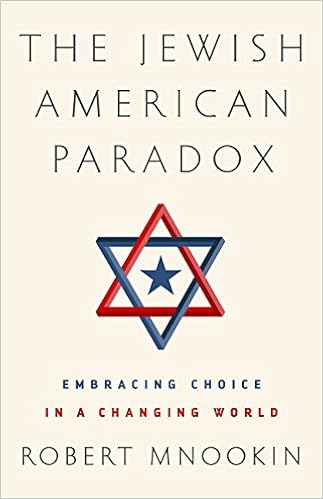
First of all, I agree with each of the positive reviewers up to this date and time. They are certainly right in their conclusion. But there is more, which you ought to know.This is a great book, an important book. Why? Well, first, it is ACCESSIBLE: it is beautifully, simply written, forthright, easy to follow. The points are explicit, sometimes even described with wonder and amazement, occasionally horror and regret. We cannot have a 'great' book if we, the readers, can't MEET the darn thing, question it, think about it, come back to it. For this book, you can.Second, a great and important book must have... let's call it "materiality". Relevance. Salience. (How would you ever possibly know this without it being accessible? Right: you can't). Reading this book, you know on each page that Mnookin is addressing at least a 3,000 year old problem. And certainly for the last 2 millennia, a problem and a puzzle that mystifies those of us who are Jews and even those who are not Jews. Shall thousands of years of history, of real people, of memories and feelings and thoughts, of accomplishments and failures, praise and blame, shall all of it pass away, be lost and expunged, remain only as a gene from a distant ancestor, a gravestone? What distinguishes folks who identify themselves as a 'people' - even as a "stiff-necked people" - and justifies their loss to all the people of Earth? And indeed if there is no justification, then how do we stop this? For surely, if we are lost today, then others will be lost tomorrow, and tomorrow is never far off. This is what Mnookin is writing about.And last, a great book must be conceived of, and written by, a person who approaches us with honesty and whose own experience demonstrates authenticity. "A wise man, a righteous man", but a man who had to leave his home to become what he did. A person who honors both thoughts and feelings with the honor that we all deserve. A person whose experience is as honest as our own, who can be trusted to lead and guide, follow and even shepherd. Somebody who seeks to transform us. And that's Mnookin. And that's who you need for a great book.I wouldn't recognize him in my WalMart, to be blunt; but I sure would recognize who he is by what he says. You need that for a great book.Mnookin is a "transformative" mediator: he looks for the opportunity to find within a conflict NOT 'compromise' but instead a lasting resolution where each party becomes engaged in the solution and in the success of the other party because all are then better off. We all live the solution together. The conflict is 'transformed' into a relationship where each side 'honors' the other and respects the outcome. So Mnookin proposes just such a transformation here. You follow him as he enters the puzzle, and see that politicians, even theologians, look for 'transactions', for accommodations, for trade-offs to decide "who is a Jew?" - as if it could be measured, or concluded from 23andMe, or determined by line-breeding in a pedigree. Mnookin patiently addresses each point, each urgency, without rancor, understanding each history, until finally he asks the simple questions: "What is the goal? What does your particular goal achieve as opposed to a different one? How would you achieve that goal and remain honest to who you really are? What would happen if your goal were achieved? Could we all live with it? Can you bear being wrong?"Simple questions that end up giving him a vision of, well, who is a Jew? Mnookin deals with the inconsistencies that have led us into the paradox, and shows us the way out. And then, if we honor each other and are all together in this big tent in the middle of the desert on the way to our place in the world, then what are the risks? What are the benefits? How do we do it? If we ALL transform our collective vision of Judaism, are we better off?You can follow Mnookin as he sets across the desert with us at his back, reading his book, for it certainly deserves to be read. (And we are, well, a "People of the Book"). Whether Mnookin, or any of us, will live to do any more than glimpse what we hope for is, well, not clear. And so history asks us to hope.And for those of us who read this book and who are American - as Mnookin affirms and re-affirms, and as I so affirm here - we should remember the American who said, "We must, indeed, all hang together, or most assuredly we shall all hang separately." So, thanks for this book, Mnookin.
Mnookin brings one of the best intellects among contemporary legal scholars to the question of what it means to be Jewish in modern America. The exposition combines analytic skill, extensive research, beautiful - and accessible -- writing (how on earth did he manage to preserve that through a lifetime in academia?), and considerable personal insight. His basic theme is how to foster Jewish identity in the conditions of modern American society that differ fundamentally from any prior historical context -- and that challenge assumptions that have governed the Jewish people for many centuries. He focuses particularly on the questions raised by dramatically increased inter-marriage, a much more secular society, waning (though not eliminated) anti-Semitism, and evolving relationships between American Jews and Israel. Spoiler alert : he advocates a "big tent" system, which will, I expect be highly attractive to many and deeply troublesome to others. But he casts his presentation in respectful, informed terms that should make readers think as carefully about the issues as he has done. An audience that should find the book particularly important, are people like me who are the non-Jewish spouse in a "mixed" marriage. He concludes the book with a practical and powerful set of suggestions for how parents in such a marriage can develop in their children a strong sense of Jewish identity while living in and respecting a vibrantly pluralistic society.
Rating:1st Star - because Amazon requires at least one star2nd Star - because despite my problems with the book, it tackles a very difficult problem and still manages to be surprisingly readableMy review is broken up into:1. Addressing Mnookin’s “Big Tent Standardâ€1a. Problems with the formulation1b. The Standard’s myopia2. Mnookin misunderstanding the paradox3. Mnookin’s issues with Orthodox Judaism3a. Misinformation3b. Misrepresentation3c. Missed Opportunities4. Some things I found to be out of place5. Conclusion1a Problems with Mnookin’s formulation of the Big Tent StandardMnookin’s proposal has two parts:1. “For the American Jewish community as a whole, the standard should be public self-identification.†(p117)2. “Each organization or group under the Big Tent may set its own boundaries for membership and participation.†(p118)Problem 1: Part Two of the proposal obviates the first partA man who is matrilineally Jewish community and identifies as non-Jewish (Part 1) would still have to fend off Chabadniks trying to get him to wear tefillin (Part 2).A woman who has no Jewish ancestors and has not converted can considers herself Jewish (Part 1), but she wouldn’t gain much (Part 2). There might be a few additional people who’d consider her Jewish, but it would give her the universal (or near-universal) Jewish identity she probably desires.Problem 2: Self-identification is rarely the sole determiner of identityFrom “hipsterâ€, to “natural bodybuilderâ€, to “womanâ€, to “Mormonâ€, these terms can not be affixed to a person’s identity solely by self identification, and certainly not a communal one like “Jewishâ€.This is expressly apparent with Jews for Jesus. They can tell me all they want that they are Jews practicing Judaism, but they aren’t Jewish simply because they identify as Jews or because they belong to an institution that identifies themselves as Jews.1b The Big Tent Standard is short sightedIt is short sighted in two ways: geographically and historically.Geographically because Mnookin’s standard is limited to America. But America is just part of a global, dynamic Jewish community. It seems rather arbitrary to limit it to America. I suspect that Mnookin limited it because he doesn’t believe non-American’s would have interest in honoring his proposal. The proposal as stated is limited and arbitrary geographically. Expanding the proposal makes it pragmatically unworkable for a global Jewish community.Most of Mnookin’s discussion about standards of Jewish identity go back ~170 years, which is totally understandable because that’s about the age of the American Jewish community (apart from a few select outposts). This is small compared to the age of Judaism, which has lasted longer than any modern nation. Judaism (along with Hinduism, Christianity, etc.) will likely outlast America (or at least a government and society that is contiguous with the current country). Mnookin doesn’t make his standard pressing.Why now? Mnookin doesn’t think that intermarriage will destroy American Jews, so what’s so pressing that we adopt this standard when our hodgepodge of religious and social standards have worked fine? Sure, there are some people who want in and some people who want out, but there doesn’t seem to be much of an uproar about it. If there is an uproar, it is about how specific institutions (esp. Israel) dictate membership, and that discretion is allowed by the Big Tent Standard!2 Mnookin misunderstands his paradoxMnookin asserts that in the past “Jewish identity was supported by five traditional sources: descent, religious affiliation, endogamy, anti-Semitism, and support for Israel. Today fewer of us find those sources meaningful or inspiring. For Jews like me, who find no comfort in religion, what is our Jewish identity based on?†(p222)My answer: those five items he just listed.In the book, he cites the Pew Research Center showing that ~70% of American Jews affiliate with a religious denomination. (p54) He also quotes that ~70% of American Jews have an emotional attachment to Israel. (p165) So, even without considering the other 3 sources, there are likely 80+% of Jews who find their Jewish identity in one of those traditional sources.But as I stated, I believe Mnookin misses the paradox. The true paradox is stated on the following page: “I reject the matrilineal standard as a way of defining who is a Jew in America today. Its religious pedigree isn’t as ancient as most people think; it was created by rabbis after the biblical period for reasons that aren’t clear. More important, it leaves no room for choice… I believe that everyone, whether Jewish by birth or not, should be allowed to choose for themselves whether and how to be Jewish.†(p223)It appears that Mnookin’s paradox isn’t that because the other sources of identity have diminished all we are left with is the religious standard; it’s that Mnookin believes that the religious standard is fundamentally wrong.This is a classic cultural conflict in America, between our value of independence and many of the other values we hold (marriage, equality, etc.). The two chapters in the book that cause Mnookin the most tzuris are Chapters 2 and 6, which both hinge on this conflict.The paradox between American identity and Judaism’s matrilineal standard is an important topic. However, Mnookin does a poor job at handling this subject matter.3a Misinformation about Orthodox JudaismMnookin makes several errors in his book about Orthodox Judaism. For example, he says “Jewish law imposes both affirmative and negative obligations on men, only prohibitions on women.†(p52) Which just isn’t true. Women are obligated in affirmative commandments (e.g. charity, tithes, etc.). They are not obligated in some time-bound commandments, but are still bound by many (e.g. keeping Shabbat, fasting on Yom Kippur, etc.)I won’t list all of his errors here because I’m not a rabbinic scholar and because these errors are not central to his argument. However, they are indicative of his lack of knowledge about the subject matter that is the core of the book: an argument against using the matrilineal standard.3b Misrepresentation of Orthodox JudaismMnookin’s plea against the matrilineal standard is outside of halacha (Jewish religious law), which is understandable. But then he doesn’t properly portray those who hold by the matrilineal standard.He says “all forms of Orthodoxy require tremendous discipline. Orthodox life is hard. It’s inconvenient. And it’s meant to be.†(p50)I read this line to my wife (who didn’t grow up an Orthodox Jew, but now is) and she said “No it isn’t. Life is hard.â€And I couldn’t agree with her more. Being a dirt bike racer is hard and inconvenient. Being a writer is hard and inconvenient. Being a jazz musician is hard and inconvenient. These are not the salient parts for those practitioners. If anything I find keeping Shabbat is hard, not because I can’t use my cell phone, but because the rest of the world expects me to be available. I find great enjoyment in Shabbat (and in observant Judaism). Many of us find Orthodox Judaism to be meaningful and fulfilling.I don’t know what Mnookin is getting on about making Orthodox Judaism out to be a slog and a downer. This sour portrait primes his readers to reject the matrilineal standard.3c Missed Opportunities when talking about the Matrilineal StandardMnookin’s lack of knowledge about observant Judaism hampers his arguments considerably.In Chapter 2: The Matrilineal Principle, 25 of the 56 citations about matrilineal descent are from one author Rabbi Dr. Shaye Cohen, with a few more from Chabad.org articles. [21 other citations in the chapter concern Madeleine Albright]. For what is the center of Mnookin’s argumentation he mostly just parrots one rabbi, who--while he does have Orthodox smicha (ordination)--has mostly worked for non-Orthodox institutions and writes academic pieces, not religious pieces.Through the entire book, I do not see one citation from a contemporary Orthodox Jewish religious treatise. There are certainly many esteemed rabbis that present nuanced interpretations on this important topic, but Mnookin doesn’t discuss their works at all. I will grant him that these are deep and complex materials outside of his expertise, but probably worth it for him since this is his entire hang-up.Again, I’m not a rabbinic scholar, but his one treatment of Cohen’s interpretation of a Mishnah is at best misleading. I will be generous to Cohen and assume that Mnookin simply misunderstood Cohen’s interpretation or lost the thread in summarizing it.The crux of Mnookin’s argument against the matrilineal standard culminates in: “‘What compelled [the rabbis] to depart from the biblical tradition and from the practice of the Second Temple period’--both of which were patrilineal? We don’t know. The rabbis left no explanation. Cohen considers a number of popular theories and rejects them all.†(p34)Mnookin passes the buck. We’re supposed to trust one scholar? Some Harvard buddy of his? [You like that ad hominem, dontcha?] We aren’t given any of the theories or arguments? This is very disappointing. Readers might (and likely would) disagree with Cohen. Likely most of the readers are Jews after all. But we aren’t even given the chance. Now I have to go pay $34 to read Cohen’s article off JSTOR?Mnookin finds the matrilineal principle arbitrary and the rabbinic pronouncements non-explanatory. Here I believe Mnookin’s legal training might be getting in the way of his understanding. Halacha (Jewish law) is an entirely different framework (ontology, Weltanschauung, whatever) from American jurisprudence. The rabbis were not necessarily trying to be explanatory (and sometimes they intentionally delayed explanatory measures). There is also a wealth of rabbinic literature on seemingly arbitrary commandments. We have a word for them: chukim. If Mnookin had availed himself of some scholarly religious texts, he might have come to a different conclusion, or at least provided more insight than “these religious rules are arbitrary and irrational.â€4 Some non sequitursMnookin spills considerable ink on the lives of Erik Erikson and Madeliene Albright. They are both interesting stories and Erikson is important as the identity theorist, but they are fringe cases that aren’t representative of the paradox. Most Americans of Jewish descent are nobodies and if they choose to walk away from Judaism, the world is none the wiser. Erikson and Albright are exceptions. We don’t even get a proper explanation or application of Erikson’s work and how it applies to the paradox.The other head scratcher is Chapter 4: The Puzzle of “Jewish Bloodâ€. Mnookin goes on about DNA tests, heredity, and ancestry. The whole concept of “Jewish blood†could have been torpedoed with a simple sentence like: “Everyone agrees that there are Jewish converts who don’t have any biological relationship with the descendants of Isaac, therefore Jewish blood isn’t really a thing.â€5. ConclusionI didn’t even get into issues of descent, Israel, antisemitism, and so much more. There is a lot to disagree about here. His straightforward proposal though? His Big Tent Standard? It’s empty and it’s supported by rubbish.This book says a lot about American Jews, but that’s due to the meta-story of Mnookin, his process of coming to write this book, and the book he produced. I see it as a window into American Jews, the questions they have, the changes they’ve experienced, and the conflicts they’ll face. There are plenty of more efficient ways to acquire this knowledge though.
PDF
EPub
Doc
iBooks
rtf
Mobipocket
Kindle
This post was written by: Author Name
Your description comes here!

Posting Komentar